Monday, September 25

And talking of style.....


It doesn't get better than this....
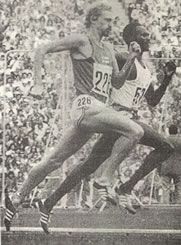
in full flight down the finishing straight of the 1972 Olynmpic 1500 final, eventual winner Pekka Vasala of Finland and the legendary Kip Keino of Kenya, the race favourite.

Toledos: keep in touch

A special message for my former team-mates in Toledo Runners:

dudes, I have been "struck off" the email list so will miss your race reports, tales of injuries :) and invitations to have ice cream...

never fear, when I have something staggering to tell you I'll email you all privately -- feel free to do the same!

Calling all Magical Milers

A spin-off from the hunt for a coach is the formation of the Magical Milers Club.

This came about when I consulted Coach to the Champions Sir Bobby McGee for his opinions on coaches. We rapidly got side-tracked, as we both share a fascination with fast miling. Bobby declared himself interested in my own Mile Project and started cooking up ways he could help. At his suggestoion I've started gathering together a group of 4 or 5 runners -- probably all Masters -- who want to do a Very Fast Mile. Right now that means breaking the 5-minute "barrier".

Yes, never mind the 4-minute mile, we're past all that. But for men around 45 onwards and women in their 40s, getting under 5 minutes for one mile is special. What we're intending to do is target the Pearl Street Mile and track events around the same time -- that's August 2007. If we have to, we'll organise our own Invitational track meet with the specific intention of getting everybody in the group under 5 minutes.

Preparing for a mile is tough. But the good news is that you can prepare "as if" for a 5k until the last few weeks, then add very specific training.

I'm happy to say that the first person I approached about the Magical Milers, marathon great Benji Durden, immediately said he was "in" and is putting the word out. We've got a very fast woman interested, too. This is going to be fun!

Sunday, September 24

Wanted: coach, must have experience and gsoh

It's ironic that a few days after wondering on this Blog, "Is the magic in the coach, the schedule, or the runner?", I find myself with no coach, no schedule and not running.

Gabino decided it was time for me to "graduate" from his group, having taken me as far as he could. So far that although I was in a group, I had been running most of my workouts on my own because of the pace I needed to hit. He gave me two leaving presents: the promise of an expenses-paid invitation from the organisers of the Carlsbad 5000, the world-class 5k road race held every year in April in California; and a referral to Steve Jones, the former world record-holder in the marathon, and one of Gabino's own coaches.

Living in Boulder you'd think that finding a coach would be easy enough. Not so. Even assuming I can get hold of Jonesie for a chat, his group may be way too fast for me. And although Boulder is swimming in coaches, most of them are ex-elite athletes who know what worked for them and work that system. They are almost all marathon-orientated. Those that have the know-how to tune in the speed for a super-fast 5k don't know anything about preparing for the mile. Those who do, don't have groups.

So meanwhile, no schedule. I've been corresponding with Tony Benson, the "Run with the Best" coach in Australia (see links) who runs a mentoring and long-distance coaching scheme. The problem there is that he wants me to provide my year-long program so that he can offer advice and tweak as the year goes on. A year's schedule? I've been working week to week. I had a funny exchange with Dwight about that. We have such different motivational styles -- me being an "options" type, and he being "procedural". Dwight likes to see the whole year laid out so he knows exactly what he's doing day by day: it adds detail to the vision and makes it more real to him. Me -- it fills me with dread and stifles me. I want to keep my options open.

I do like to have very clearly defined goals, then an overview of how I am going to get them (the big picture). I deal with the details in smaller chunks. If I know I am going to be doing a phase of highly-specific pre-race training in, say, March 2007, I really don't need to know right now what specific workout I am going to be running on March 12.

The not-running is Bobby's fault. I was complaining at Drills last week that my groin and adductors felt completely seized up. Well, I should have mentioned it earlier, shouldn't I? The mystery, niggling, not-quite-an-injury that has been bothering me for months -- Mr McGee diagnosed the cause in two minutes flat and immediately recommended time off to let it heal -- the groin being a tricky area to deal with.

So. No coach. No schedule. No running. Yes, at some level it feels liberating. But I am finding the less I do, the more tired I feel. As for finding a coach, well it doesn't feel urgent any more. What's going to be more important is finding people to run with through a winter of base-building.

Wednesday, September 20

So, who's got the best style?


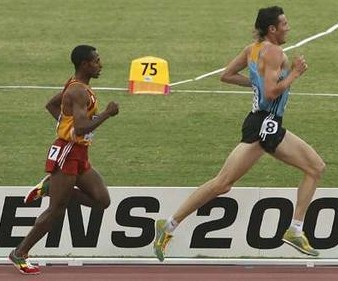
In the lead: Australian Craig Mottram -- the "jolly green giant" of middle-distance racing compared to the little, fast-striding Africans he habitually finds himself up against.

Thanks to Super-Coach Bobby McGee for sharing this one. He was sent the picture by an Australian coach -- Down Under they all think Mottram has a superb style. Bobby's comment: never mind Mottram, the guy behind him is a MUCH better model!

Check out the Australian's upper body. He looks as if he is so knackered that as he ties up he has gone past upright to the point where he is almost leaning backwards. And as I have certain "issues" with my arms, Bobby wanted particularly for me to clock what Mottram is doing with his. Let's just say they are not where they should be.

Compare and contrast with the great Kenenisa Bekele of Ethiopa, world record-holder at 5,000 and 10,000m. Balanced, compact, forward-leaning, great flexibility.

Mottram has not beaten Bekele in three years...except ironically in this race where, running as team captain, he pushed himself to a PR of 7:32.19 to became the first Oceania athlete to defend a World Cup title.

Tuesday, September 19

Henry's Quote of the Week

"I have to hold-back my horses. you are right! Strong head can ruin the knees for sure."

Henry Rono.

Friday, September 15

'Scrawl it on the inside of your eyelids...'

Is the magic in the coach, the schedule, or the runner?

I'm beginning to think that the greatest gift a coach can bring to the table is the ability to encourage people to train consistently over time.

Yes, there is the technical aspect of knowing/feeling numbers and quality of reps and intervals and hills, but the most important thing is to keep people at it. That's where "the schedule" comes in. You get it once a week and know roughly what you'll be doing when... it makes it easier to find the time and to motivate yourelf knowing that there is a purpose to it AND a group of people waiting for you at 5pm!

In the group I have been training with, the schedule calls for 40-50 miles a week covered in 7 days (no rest day). But I've averaged 33 miles a week for the last year and don't know anyone else who has totally followed the program. Yet we've all improved.

Thanks Emilie, for the comments that helped me get clear about this. It follows on from Kevin Beck's words from the last post. Please follow the link in that post (below) and read his article... if you are a runner it'll do you so much good. Here's another snippet to encourage you (the emphases are his):

"Patience, trust, resilience, and the ability to learn from past experience
are the greatest psychological determinants of success in long-distance running, just as they are in other realms. The greatest physical determinants are, regardless of your event, an aerobic base developed through years of accumulated mileage and - just as important - consistency (a by-product of resilience, both physical and psycho-emotional). Believe this philosophy, scrawl it on the inside of your eyelids, live it, and regardless of your inherent abilities, you'll look around one day and be pleasantly astonished at your own improvement and achievements.

Pared down to the essentials, then, hard work and confidence are all a distance runner truly needs. I have found that regardless of whatever permutation of miles, intervals, tempo runs, hill workouts, and long runs I settle on for any given stretch of training, the thing that matters most is nudging your total time spent training ever higher until you find your personal "sweet spot" and only then, when you're ready to attack a period of racing, become truly concerned with intensity."

Thursday, September 14

All you need to know about training

"Run as much as you can as often as possible and run like hell when moved to do so."

Thanks to distance runner and coach Kevin Beck for this piece of essential wisdom -- included in his great article, "The secret you've been looking for..."

This training business is not all that complicated, now is it?

Tuesday, September 12

Running as ceremony

They ran to make rain, to honour the dead, to generate healing. They ran to send news and get reinforcements. They ran for power and for prayer.
Yep, the American Indians knew a thing or two about running, as I've just discovered after finding an out-of-print book on the subject.
One of the bits I liked most was this Navajo chant (a "Leg Song") that their runners used, that just about sums it all up:

"The mountain,
I become part of it...
The herbs, the fir tree,
I become part of it.
The morning mists,
The clouds, the gathering waters,
I become part of it.
The rain that sweeps across the earth,
I become part of it.
The wilderness, the dew drops, the pollen...
I become part of it."

* From "Indian Running: Native American history and tradition" by Peter Nabokov (Ancient City Press, New Mexico 1981).

Saturday, September 9

Outbreaks of good sportsmanship

Colorado is the first place where I've lined up for a race -- a championship race at that -- and had someone next to me in the front row shake my hand and wish me a good race.
So maybe I shouldn't have been surprised at another outbreak of good sportsmanship at the Blockbuster 5k last week.
With about half a mile to go I'd just caught the guy in second place and we'd both been joined by another runner. In the confusion of trading pl;aces I led everyone slightly off course. In the process of getting bac k on course, the runner who had been third ended up 25 yards in front of me. To my astonishment he slowed down and waited for me. "Go on", I said, "you were catching me anyway". "No, no", he said "you were in front".
What then followed was a bizarre routine of "no, I insist, after you..." all conducted at speed, with one eye on the fast-approaching finishing line. We agreed to run in together... but at the line he pushed me in front.
He disappeared after the finish, but at least I can recognise him "officially" here: so thank you Paul Reich of Telluride - you are a gentleman!

Thursday, September 7

Running with the moon

This month's full moon -- the Harvest Moon -- is a humdinger. It's close to the Earth and looking huge.
No wonder I have been able to stick in a few extra miles.
For a while now, I've been experimenting with co-ordinating my training with the moon's phases. I got the idea from the vascular surgeon Dr Irving Dardik. A founding chairman of the US Olympic Sports Medicine Council, Dardik was at one time banned from practising medicine because his peers thought his ideas on biological rhythms were too outlandish. But they make a lot of sense to me.
Dr Dardik designed an exercise programme that realigned patients with the natural cycles of the environment. With carefully timed periods of exercise, Dardik found he could nudge people's onboard biological computers back into synch and actually recreate a healthy system; he got some amazing results in people with chronic diseases.
Dardik's big idea is that life is a wave, not a straight line. Everything occurs in cycles. One week we're up, one week we're down. Birth rates, death rates, accident rates. Heart rates, even. Plot them on a graph, you'll see waves.
When I looked back at my training diaries I saw the same cyclic pattern.
This natural phenomenon is one of the reasons we have coffee breaks. Within the 24-hour sleep/wake cycle, there is an ultradian rhythm that produces natural peaks of activity and rest every 90-120 minutes. Waves within waves. We're healthier when we respect the ebb and flow of our energy.
One of the ways to "ride the wave" of biological rhythms, Dardik said, is to tune exercise to the phases of the moon. Full moon is a high energy time. New moon is a low energy time. Join the dots. After the new moon, you may find your energy starts to pick up, building to a peak of activity around full moon, when it starts falling off again towards the "trough" of new moon.
So...do your highest-mileage weeks (and races, if possible) leading up to, or at, full moon. Have your easy week around new moon. When we're heading into new moon, I don't push myself in training and I am hyper-vigilant for signs of impending injury.

* Information on Dr Dardik is hard to find. His Institute's website has been passive for more than a year. There is one book, by science writer Roger Lewin, that tells the full story: "Making Waves: Irving Dardik and his Superwave Principle" (Rodale, 2005) and that's it.

Tuesday, September 5

Doing what it takes

"There are always far more athletes who wish to be the best than there are athletes who are willing to do whatever it takes to get there".

So says Tony Benson, a Lydiard and Cerutty-inspired Australian coach, author of a great "how to train" book called "Run with the Best".

My friends Dwight and Kari Cornwell introduced me to Tony's work. I find myself reading bits of his book avery day; the last time I did that was with Arthur Lydiard's "bible" back in the '80s. Yet Tony's system strikes terror in my heart, as he is definitely a believer in high mileage. I averaged 33 miles a week in the last year which, according to Tony, pretty much means I am still in the "training to train" phase!

Tony bemoans the fact that Australian runners are no longer at the top. And he blames the Kenyans for it. Well, not the Kenyans, exactly, but people's fear of the Kenyans, Ethiopians and Moroccans and the limiting belief that these runners have special genetic gifts or training secrets that means that we can't get near them. The truth of it is -- they train harder!

Tony quotes British champion Bruce Tulloh, who after spending a year in Kenya in the 1970s, said that the Keyans were doing about half the training that Americans or Europeans were doing. Tulloh predicted that when they got disease and malnutrition under control, and were able to train properly, the Kenyans would dominate. Of course, he was proved right.

Tony tells us: "Kip Keino, acknowledged by all the Kenyans I spoke to as their all-time great...might not make the Kenyan top 100 any more. He trained 6-8 times a week. Modern Kenyans train 12-18 times per week." Yes, they are prepared to do what it takes.

As someone raised in the land that produced the likes of W.G.George, Alf Shrubb, Bannister, Pirie, Foster, Ovett, Coe, Cram and all, I am bit embarrassed that the only British runner I look up to these days is Paula Radcliffe. Is there something about our modern lifestyle that means Australian, British and American runners just aren't prepared to do what it takes any more? Or do we blame modern coaches?

Hmm. I am asking myself why I'm only prepared to do 30-40 miles a week. This has got to change.

* Quotes from "Australian Middle and Long Distance Running into the 21st Century", an article on Tony Benson's website. The full article (pdf) is here.

Thursday, August 31

Pain and suffering anyone?

After a workshop at Fleet Feet Boulder I collared former world marathon record-holder Steve Jones and asked him my burning question of the time: how did he handle the pain involved in running a world-record performance? I mean, what strategy does he have for red-lining and being able to keep going?

I was expecting some revolutionary secret tip. Instead, Jonesy looked at me as if I was a bit crazy and said, "Well, it's got to hurt!"

The problem is that when every race hurts, you rapidly lose your appetite for racing. Gabino has taught me a little bit of what it means to suffer like a Mexican in races. He's passing on what he had to go through to beat the first wave of Kenyan runners arriving in the US hungry for prize money. "The Kenyans will go out at 4:02 pace", he told me. "They are in pain from the first mile and they are dying until the end -- that's why you see the fast times".

But who can race like that all the time? Certainly not the elites like Jonesy, who picked his races very carefully; nor the Kenyans, who were usually burnt out quite quickly. So I don't believe any more that racing is always about huge amounts of suffering: it doesn't have to hurt -- unless you are going for a world record or doing whatever it takes to win. I agree with Ahmee's comment: "Yet, a PR isn't nearly enticing enough to forgo a beautiful marathon venue or to push through barely tolerable pain (there are limits to my masochism). "

Lately I've been experimenting with running some low-key races and keeping my effort on the easy side of my pain threshold. As a result, I am able to focus on staying relaxed and looking good! I can monitor my form, my cadence and my breathing, and talk-feel my way into an ideal rhythm. I like it! In a 5k at the weekend I took it easy; with a mile to go I was still relaxed and waiting to be caught by the guys behind me (I was in third), but then realised I was actually gaining on the runner in second place. I caught him and went straight past, feeling strong and fast. I didn't suffer at all. Amazing!

Meanwhile, back to marathon-bashing... and Ahmee's comments. No, you don't have to have gobbets of pain and suffering to be racing, but you do have to be pushing your limits in some way, surely? Otherwise, why race? Why make an exhibition of yourself in funny clothes on pubic roads for hours on end? In fact, the scenes of carnage at the end of the average marathon (and even half-marathon) are not to do with the fact that running 26.2 miles is hard, but because people don't prepare for them properly. For most of the people at the back end of the field, it will be the first time they have got anywhere near the distance. That is no way to train for anything, but I guess it helps them with the charade that it is some sort of unbelievable challenge.

Here's a guy who says it all better -- and more strongly -- than I can. The aptly named "The Rage" of www.10ktruth.com has been ranting about John "The Penguin" Bingham, a man who seems to thnk that finishing a 5k (that's just three miles), let alone a marathon, at walking pace, is a Very Big Deal.

"The key problem I have with Bingham in the context of running is that I don't see him interested in testing the limits of what he as an individual can really physically do…what it's like for Joe Average to really explore the boundaries of his comfort zone once he has committed to put down the channel changer, the pack of smokes and strayed more than 20 feet from the fridge. He overdoes 'the courage to start' thing to an extreme, almost as if a little anaerobic breathing might scare someone right back onto the couch again. I wish he would do more to encourage people to push themselves to another level. I believe this is what the human spirit is all about...not about making excuses like "...it was not comfortable, so I quit…"


"The Rage" concludes: "If mediocrity is his thing, fine. He can still encourage his followers to finish a marathon. Just leave out the 'run' part and I'm OK. Just to set the record straight, I didn't run my last marathon, either. I walked part of it. Of the six I have completed, I have run four…but I am still proud of all six. And I also admired every one of the people in the race, too. Runners, walkers...and joggers."

* Read the full Rage on the The Penguin here.

Monday, August 28

Marathon disease.. and those 'less athletic' runners

Ahmee posted some great comments about my rant on the marathon 'disease' (click on the comments button at the end of 'A nice cup of tea' section below to see her full post). She took me to task for being too hard on "less athletic" runners.

"I think that you just don't "get it" about why less athletic runners enjoy running, and not racing, for 26.2 miles. Masochism for its own sake is only part of enjoyment. Planning to run a marathon in five hours provides a sense of adventure, a domain where I can push my own humble limits, and a goal race that allows for many months of sociable training, plus an incentive to stay fit, strength train, eat right, and obsess about something not too disturbing", she said.

Maybe I wasn't as clear as a I should be. My "irritation", if we can call it that, is with people who think that being able to run 26.2 miles is special. So special, that if they do it they deserve a medal. Not to mention a t-shirt, a commemorative glass, a bag of freebies and a post-"race" celebration. Running 26.2 miles isn't special. Any more than walking it is. It's what our legs are there for.

Anyone planning to finish it in five hours, to match their friend's pace, to beat a PR -- and I don't care how slow it is -- them I can respect.

I do apologise if the tone of my post was that I think "less athletic" runners are a waste of road space. I didn't mean that at all. What is a "less athletic" runner, anyway? In my book it's someone who has not got the time or the inclincation to do enough training; that's all.

That reference made me laugh out loud. When I first turned up at a Bobby McGee drills session with a 27-minute 5k and a 48-minute 10k to show for myself, I certainly rated as a "less athletic", mid-pack runner. One year on, having improved those times by 10 and 11 minutes respectively through a year of hard, hard training, suddenly I am, what? "More athletic", I guess! I've even had thrown at me the priceless, no-brain comment, "It's easy for you, you've got talent!" That one had my coach Gabino Toledo almost on the floor with laughter. He was the only one with me when we trained in the dark at Centennial, heaving around bags of sand until my back went out; he was often the only one running with me in the snow and ice on those winter mornings, when the "less athletic" were tucked up warm and cosy in bed. Ha!

Ahmee also makes a great point about suffering and masochism, which I'll get to in the next post.

Sunday, August 27

Congratulations if you ran today!

It doesn't matter how far or how slowly; well done for getting out and doing it!

This isn't one of those "we're all winners" spiels ("we're all whiners" is probably more accurate anyway), but just a recognition that we regularly manage to overcome inertia and that, once again, we truimphed: we actually got out of the house!

The thing is, this running lark takes so much time. I am writing this at 3.40pm, a point at which I can just about claim that the day's run is over and done with. But I started preparing for it at 7.30pm last night. That's when I started negotiations with my nearest and dearest for an early night instead of going out for dinner.

At 6am I was up and brewing the first of 3 cups of tea and preparing breakfast. OK. two bananas and some raisins doens't need much preparation. But I did have to prepare my drinks -- one for the run, one for after the run. Get the various bits of kit together, get in the car, get myself up the road to meet Dwight and Kari five miles up Magnolia at around 8,000 feet for a 7.30am start.

Two and something hours later, it's time to start the recovery process. Feet up while drinking the recovery drink (sometimes the most difficult part of the day). Then off the mountain for breakfast and lots of it. Ater breakfast, more tea, plus ice cream, then a nap. Massage legs. Ultrasound hurty bits. Apply DMSO. Cat decides it's time to sit on my chest and have a 20-minute wash while I laser other hurty bits. Pinned on the sofa by the cat, more tea, before reluctantly getting myself together for the ice bath. Hungry again. More food. OK... ready to go. "What shall we do today, sweetie?" Hmm. 3.50. There went Sunday.

Thursday, August 24

A nice cup of tea...

I drink a lot of tea. It's part of my British genetic make-up. It's also about the only physiological thing I have in common with the Kenyans.

I've been drinking tea for 50 years. Well, OK, maybe a few less than that -- I wasn't actually weaned on the stuff. But during those years I've seen tea go from the Englishman's spirit-of-the-Blitz staple to a caffeinated drink that the health police said we shouldn't be drinking, and back to prized status as scientists discovered it is packed with antioxidant that are really, really good for us (especially runners).

One last drawback remeained to be cleared up. As a runner, hydration is very important. And tea, they told us, is a diuretic.

Now I know this is a bit extreme, but I like my tea. So I did a little experiment. I collected and measured my output of urine over two 24-hour periods with and without tea. I compared the quantity coming out with the quantity going in. There was no difference. Conclusion: tea is not a diuretic.

Today I was pleased to discover that scientists at Kings College London agree. "Tea not only rehydrates as well as water does, but it can also protect against heart disease and some cancers", reported BBC news. And lead researcher Dr Carrie Ruxton actually said that the idea that tea was dehydrating was an urban myth.

"Studies on caffeine have found very high doses dehydrate and everyone assumes that caffeine-containing beverages dehydrate", she said. "But even if you had a really, really strong cup of tea or coffee, which is quite hard to make, you would still have a net gain of fluid.

"Drinking tea is actually better for you than drinking water. Water is essentially replacing fluid. Tea replaces fluids and contains antioxidants so its got two things going for it."

* Story from BBC NEWS:
http://news.bbc.co.uk. Paper: EJ Gardner et al, Black tea – helpful or harmful? A review of the evidence. European Journal of Clinical Nutrition, 2006, advance online publication 19 July.

Wednesday, August 23

Marathon disease....it's getting worse


Marathons. People are obsessed with them. Not with racing them, just with finishing. As if putting one foot in front of another for 26.2 miles is the equivalent of climbing Everest or something.

Don't they get it? Humans are designed to cover long distances on foot. There's nothing special about it.

Those that have done a few soon get to realise that. They're left with two options: train like a proper runner and do a marathon in a decent time, or run longer: run 50 miles, or 100 miles instead. In the context of a world marathon record of 2:04 -- that's 13 mph for two hours -- the second option is a lot easier and much more likely to get you noticed.

Ultra-runner Dean Karnazes has got himself on Oprah following this strategy. His latest gimmick is to run 50 marathons in 50 states in 50 consecutive days, for which feat he has already won a ton of sponsorship and full-colour 8-page (yes eight) advertising spreads in the running glossies. Amazing. The hype, not the performance. It's already been done.

" 'Normal Guy' Thompson Finishes 51 Marathons in 50 Days" headlines Runner's World news service this week. "Sam Thompson, hoping to raise awareness of Hurricane Katrina victims, finished his quest with 26.2 miles in Bay St Louis, Mississippi on Saturday, after 26.2 miles in New Orleans the day before. He even added the District of Columbia to one of his one-marathon-per-state days. 'He's a totally normal guy', says Thompson's girlfriend. 'He's just very driven. He's got a great deal of passion and intensity.'

Meanwhile, Chuck Engle, a 35-year-old from Columbus, Ohio, is running 52 marathons in 52 weeks -- at a decent speed. So far he's done 34. "The fastest was a 2:31:34 in Sarasota. The slowest was a 2:54:54 at Gateway to the Pacific in Elma, Washington, which was good enough to win. Last Sunday, Engle won the Silver State Marathon in Nevada in 2:44:52; the hilly course, a 5000-foot altitude, has a five-mile stretch of sand. 'It's such a euphoric feeling you get when you finish a marathon', states Engle. 'You cannot explain it to someone.' "

But never mind all that. The monks of Japan's sacred Mount Hiei run for seven years. In one 100-day stretch they cover 52.5 miles a day. This is while dressed in hand-made straw running shoes, with hat and stave, on mountain tracks as well as on roads. Kind of puts in perspective.

* Picture: "Ajari Sakai Yusai, veteran of two 1,000-day marathons, on the Imuro Valley Course". From "The Marathon Monks of Mount Hiei" by John Stevens (Rider, 1988), now out of print.

Sunday, August 20

Exactly...

Henry sums it all up again:

"Old in the body, young in the heart, rich in the spirit and that adds up to today training."

Thursday, August 17

How not to run a mile race


5th in 5:14. Not what I wanted, but not too bad.

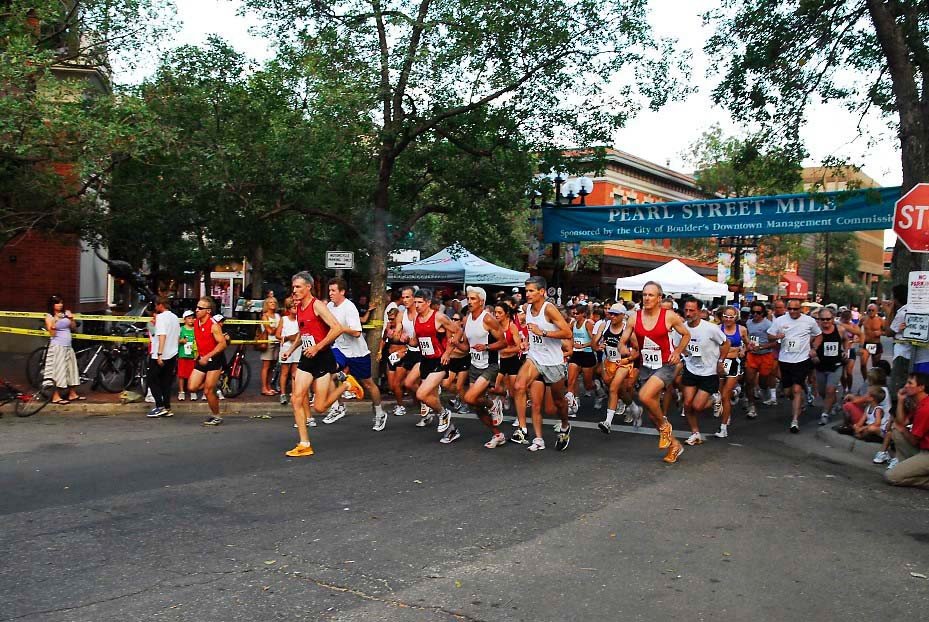
It all went a bit wrong.... I went out too fast and three of them sat on me for the first 400m. (Picture shows me going to the front right from the gun.) I had to practically start jogging to get anyone to come past me. When they did, I was trying to recover and settle in when at 800 metres ex-Olympian Colleen De Reuck looked round at us all and then attacked. I had nothing left and just had to hang on.

Scott Hajicek (51), a demon trail runner and 2:45 marathoner, passed Colleen to win in 5:05 (he is the white-haired bloke in the white vest about four runners behind me in the picture); Colleen ran 5:08; Kyle Hubbart (50 -- he won the 2-mile Sunrise Stampede in June in 11:08), got third; then Patty Murray, a former NCAA 10,000m Champion and Olympic Trials marathon qualifier, came hurtling past in the last 150m.

So.. I am not happy that I got so caught up with what Bobby McGee calls the "need to frantically reach for performance" that I lost awareness of the important stuff like rhythm, form, cadence, breathing and so on. Everything that would have let me be fully present.

Funnily enough I had worked out that 5:14 would probably win it, but this year's race was faster! Gabino said the big mistake was the start and that if I hadn't been the rabbit for the first 400 I would have had a better race; it's a question of experience. Because I was out front too early I never got settled in, and I switched to desperate survival mode.

Boulder Race Series Pearl Street Mile Beauty and the Beast Wave August 17, 2006 Results.

Any last words?

"You have the mind, take the body to the finish line. Good luck!!!!!"
Henry Rono

Missing Henry


There was an outside chance that The Man himself, Henry Rono, would run the Pearl Street Mile in Boulder tonight, but he was on his way back from a training camp for kids, and could not divert.

I'm disappointed, but also a bit relieved, as fit or not he would doubtless have run in his usual fearless, take-no-prisoners style.

All credit to the Kenyan maestro: he spent the last few days inspiring -- and being hammered into the dust by -- 7-12th graders at a Five-Star Cross Country Camp. It is great to see the Camp organisers make the point that Henry not only stunned the world by settng four world records in 80 days in 1978 (10,000, 5,000, 3,000 metres and 3,000 metres steeplechase), but that he ran without pacers and for two of them with hardly any spectators.

Henry, on the world record trail again, continues to inspire me and other masters athletes by publishing his daily training and sharing wisdom on a lets.run thread here.

Tuesday, August 15

Into the Danger Zone


With a race looming, my thoughts go to mental preparation: what's the best way to get wound up, but without over-doing it?

Should I go into a Zen-like trance, or stay relaxed and chatty; or go cold, seething and furious, like Olympic champion Peter Snell was said to do?

I just found out how Michael Johnson (above) handles it. The world's greatest runner ever over 200 and 400 meters, five times Olympic champion, nine times world champion, had this to say in an interview with former team-mate Todd Copeland:

"You're famous for your stare, or scowl, when get on the track and right before you get in the blocks. I've read that mindset sometimes starts the night before a race. You get into the "danger zone." Could you tell me what that mindset means to you. How do you use it? Is it something you work on?

MJ: That whole thing started in 1992 at the Olympic Trials when I faced my first really tough and difficult assignment, running in lane eight in the 200. Carl Lewis is just talking all kinds of crap, saying I'm not going to make the Olympic team. Basically, I knew that at that point I needed to get into a mindset where I'm so focused on running 200 meters as best as I can and not thinking about what Carl is saying, not thinking about the fact I'm a heavy favorite and I've got Mike Marsh running fast now and Carl is talking all of this stuff and on top of that I've been dealt lane eight. I need to get myself into a tunnel-vision mindset where I look at this and go, "Hey, it's 200 meters whether it's lane one, lane three, or lane eight, and I run 200 meters better than anyone else out here on this track."
It just happened where somebody after the semifinals - Carl's talking a lot of noise, and one of the reporters asked me about it. And I was like, "Hey, I'm in the danger zone."
That has always been a position for me where, basically, I just focus on what I've got to do at that point instead of thinking about what's going to happen if I lose this race, what are they going to say, what are the headlines going to say tomorrow after the race?

Just total concentration.


MJ: Yeah, just total focus on what has to be done over the next nineteen seconds.

Eliminating the whole world except for me and my lane.


MJ: Exactly. It starts usually when I go out to the track to start my warm-up because I need to be thinking. It's a very difficult thing to go out and sprint. People think it's easy, but it's not easy to do it well. It's not like when the gun goes off you just start running as fast and as hard as you can. There are different strategies involved. You've got a lot of zones to go through. You've got to concentrate on trying not to make a mistake. You're trying to make your body do something that's really not very natural. You've got to focus on that and think about that."

Found at Todd Copeland's Unofficial Michael Johnson Page. (now offline)

Saturday, August 12

Is there embarrassment all round at Reebok?

No, they probably haven't even noticed.

Their super-duper, full-color, fold out, three-page advertisment for shoes designed for heel-strikers is illustrated by a fantastic picture of an athlete -- blatantly NOT a heel-striker.

The ad is in September's Runner's World magazine and is for their new "breakthrough" shoe the Trinity KFS...."the shoe that moves with you". Yeah, right.

This shoe is so special, apparently, because it incoporates the absolute latest technology that "manages the forces of impact" and is designed to "follow the foot through" heel impact, mid-foot stabilisation and toe off. Only...er... my foot doesn't land on the heel first. Neither do the feet of any elite runner I have ever watched.

The running shoe industry is obesessed with heel strike, as it is with "over-pronation", because they are problems that sell shoes. Reebok, like all the other manufacturers, keeps quiet about the fact that 90% of elite runners are midfoot/forefoot strikers, while 90% of slow runners are heel strikers. Wouldn't the industry better serve its customers by preaching proper biomechanics, gait and form?

Heel striking is braking. It's what you do when you want to slow down. Heel striking is biomechanically inefficient and leads to injury. Especially when shoes are padded so much that they allow runners to (temporarily) get away with heel striking with locked knees.

There should be red faces at Reebok. The runner in full flight bursting across their advert is about to land... and one thing's for sure: she is not landing on her heel!

Tucked away in RW is an advert for Velocy, a shoe brand actually designed to encourage runners to run "with gravity" and get off their heels. This shoe is not included in the issue's fall show review, despite the fact that it is the only genuine breakthrough we've seen all year.


I went to the Velocy website and got suitably excited. "Conventional footwear technologies focus on the heel. That's why virtually every major running shoe company focuses on 'cushioning' and 'shock absorption'. But what if heel technologies are not the answer? What if gravity is actually a friend and not a foe?" Yes Velocy! Thank you! At last.

Velocy are so new they are still finding their way to stores and are not even available on the Net yet. So instead of buying a pair unseen and untried, I found an application to be a Wear Tester. VP Angela Talbott told me today that they're appointing me one of their testers for the month. I should get the shoes in the next two weeks. Can't wait! Check 'em out on the Velocy website.

Friday, August 11

Run like a kangeroo?

Two Dutch coaches and scientists have come up with a way of teaching running technique that draws not only on their knowledge of anatomy and biomechanics, but also on the study of the natural motion of animals.

Surprisingly, one of their models is the kangeroo. Many runners spend a lot of time trying to eliminate "bounce" in favour of straight-line power transfer. These guys suggest this might not be helpful.

Most people think that running itself is a "natural" activity and we don't need to be taught how to do it. Wrong! We may start out running efficiently and gracefully as children, but soon lose the skill. I've been privileged to learn from great coaches such as Bobby McGee and Dr Nicholas Romanov, the originator of the Pose Method of running. Adapting my style according to their precepts has sliced whole minutes off my race times without any additional effort.

So, I am open to the idea that running should and can be taught. But kangeroos? I took this up with Functional Training guru Vern Gambetta, who is recommending a DVD on the new technique -- called the BK Method -- on his website.

I asked him why he was so enamoured of BK. "Apart from the fact that I'm not convinced the kangaroo is a particularly apt model for human running, I can't see anyone in middle/long distance running of any note who is using this method -- for example Gebreselassie, Tergat, Kosgei -- you name it", I told him.

One of the runners the Dutch coaches identify as being one of their stars is Ellen van Langen. Well, she won the Olympic 800 metres in 1992 and retired in 1998 after having been "plagued by injuries" (to quote Wikipedia). I don't think these guys had even thought of their method 14 years ago. What's more, Holland is not exactly a world leader in distance running. So why does Vern like BK so much that he is championing it in the US?

Vern replied that the blokes behind BK -- Frans Bosch and Ronald Klomp -- have also written a book on running, which seems to be what convinced him.

"The Kangaroo and animal locomotion are great sources of information for bettering human locomotion. (Read Principles of Animal Locomotion by R. McNeill Alexander). I recommend you read the book before making further judgment", he said.

"Here are two coaches, who are also sports scientists who went out on a limb and looked at running a bit differently. The whole issue of stiffness is explored quite. Also the mechanics that they speak about are what great runners do. They have put this in context. After you read the book and have questions email them to me. I am going to meet the authors in Holland in October. Also a further affirmation is when someone like Gary Winckler, the greatest sprint and hurdle coach in the world, thinks there is something there I listen."

OK. So I ordered the book (see link below -- I got the last one on Amazon, but they must be getting some more in!). Then I went to Bosch and Klomp's website on the DVD: beautifully produced, with loads of fascinating clips and some stunning visuals. Well worth a look. Of course, I had to get that too! So, I'll be reporting back.

Meanwhile, I don't think I'll be bounding down Pearl Street next week... but maybe afterwards I'll experiment a little.
Thursday, August 10

'But it's only a mile....!'

Ah yes, tell people that your next race is the Pearl Street Mile and they can't understand what all the fuss is about.

"Oh! I could do that!" says Pam, the massage therapist.
"Could you do it in 5 minutes?" responds Emily, the chiropractor lucky enough to be treating my groin at the moment.

Racing one mile is hard. There is no room for error, no time to ease yourself into it, no possibility of clawing back a gap if your concentration slips. It is "be here now" stuff and I am desperately trying -- in a completely not-attached-to-outcome way, of course -- to access the Zen state necessary to be totally present, ready to suffer and so reach enlightenment: ie, win the thing.

"To be willing to do all that it takes -- deep desire -- requires the element of suffering", writes Dr Jerry Lynch, PhD, in "The Way of the Champion", the book I always read before a race.

"It is through suffering that you connect with your deepest athletic and personal self and have the vision of your ultimate greatness".

I wish I'd read that this morning before our final hard track session: 4 x 800 metres at mile race pace. Training for the mile hurts! No wonder most old gits like me drift towards the longer distances. Sure, there is an element of suffering in training longer and slower, but it is nowhere near as sharp.

Races that take between one minute and five minutes to complete take athletes into what sports physiologists call "the mystery zone". Elite performance in the mile requires both aerobic and anaerobic power.. So even although it's only a mile, you've still got to keep up your normal diet of steady running at distances from 5-15 miles or more, but on top of that you've got to do the eyeballs-out, fast fast fast stuff, too.

Nobody can tell you what the exact mix should be.
You get there by trial and error and, if you're lucky,
expert asessment and feedback from someone
who's been there and done it. Only a mile, but so hard to get right.

Saturday, August 5

You can do the extraordinary -- Roger Bannister

Just found this great quote from Roger Bannister in a commencement address by Dr Steven Gabbe, MD:

'When I decided to speak about Roger Bannister, I wrote to him and asked what message he would want me to convey. He directed me to a quote and to his training schedule. First, the quote,

"However ordinary each of us may seem, we are all in some way special and can do things that are extraordinary, perhaps until then even thought impossible.

"When the broad sweep of life is viewed, sport, though instinctive, physical and ephemeral, illustrates a universal truth that most of us find effort and struggle deeply satisfying, harnessing almost primeval instincts to fight, to survive. It gives us all a challenge, a sense of purpose and freedom of choice. It is increasingly difficult to find this in our restricted twenty-first-century lives.

"The particular target we seek may not be important. But what is important is the profoundly satisfying effort in thought, feeling and hard work necessary to achieve this success."

"Four Laps, Four Minutes, Four Years"
Commencement Speech, May 19, 2006
Steven G. Gabbe, MD
Dean, Vanderbilt University School of Medicine,
found online here.

Thursday, August 3

What IS the mile record for old gits, anyway?

Current 50-54 record is 4:27.9 set by Nolan Shaheed in 2000.

Henry Rono turns 55 in February 2007, so after that will be able to go for the 55-59 record, which is 4:40.4 (set by Australia's Jack Ryan in 1977).

The fly in the ointment is the great Nolan, who is now 55!
In March this year he set a new INDOOR world mile 55-59 record in 4:42.89. I think outdoor times are usually + 2 or +3 seconds, but we will have to see what he does.

I am watching this all very closely as I was born the same year as Henry (but 10 months later)
and, as is clear from these pages, I suffer from severe delusions of talent... whatever Henry sets will be the time I aim for in late 2007 :)

Pilates - or 'What the bleep are these muscles here?'

It's in fashion, so I've resisted it.
Hell, I did Pilates 20 years ago in London before anyone knew about it.
But then... "... and what with your core not being what it should be"... came an off-hand remark by my technical advisor, world class coach Bobby McGee (www.bobbymcgee.com)... which decided me I had to do something about it.

So, off to Pilates of Boulder fror asession with Richard Rossiter. I picked Richard because a) he's a man, b) he is not a dancer and c) he has a rich life that includes climbing, running, bike-riding and much else. He has also used his own Pilates practice to rehab himself back from the brink of wheel-chairdom after a front tyre blow-out on his road bike.

Today I am wondering what the bleep are these muscles at the back of my knees -- and why I have never used them before! Yeah, I may have thought Pilates was all about flavour-of-the-month core strengthening, but no, it is about much more than that.

After one session on the Reformer, a sort of rowing machine for the legs, I know I am going to see some sensational results in my running as the routine re-activates and strengthens muscles I have hardly been using.

When it came to the wunder-chair, a spring-loaded step-up device, I nearly couldn't finish the reps -- and my quads are toughened by MANY hill reps. Besides all that, the breathing technique is different - and I'll report back on what that's doing to my oxygsn uptake. "No belly breathing here", is Richard's take-home message.


* Pilates of Boulder

Tuesday, August 1

Fastest mile so far

Tonight's post-training conversation with my wife Abby:

"What's the fastest mile you've ever run?" Well, I haven't run it very often - but I did 5:30 about 20 years ago on the track at Crystal Palace in a relay event.

"What do you think you need to do to win the Pearl Street Mile?" In the Beauty and the Beast event? About 5:14.

"What did you do in training tonight? You were doing a one-mile time trial, right?" 5:03!!

Monday, July 31

'You can always do one more'

"There's only one rule: The guy who trains the hardest, the most, wins. Period. Because you won't die. Even though you feel like you'll die, you don't actually die.
"Like when you're training, you can always do one more. Always. As tired as you might think you are, you can always, always do one more." --- Floyd Landis

Seeing Elvis

Just back from the 10 minutes x10x10 workout -- did it on grass at the futbol pitch -- what a great session!

This is a test of will-power as much as anything, and builds in the ability to surge even when you are "dead". As part of the cunning plan it is also constructed so that if you are aiming to run a mile in five minutes, say, then that is just what you will cover, at speed...

OK, so to translate the equation. You set your watch to bleep every ten seconds (or your GPS monitor to screech, which mine does).... you sprint for ten seconds, jog for ten seconds, sprint for ten seconds and so on -- until you have been running for ten minutes and/or are starting to hallucinate.

My coach Gabino Toledo, who sets this torture up, refers to this hypoxic state as "seeing Elvis" -- because, you know, sometimes you do!

Well this felt really good... especially I think as I was doing the workout on my own and it was getting dark... so I tapped into the British runenrs' racial memory of Pirie, Foster, Ovett, Coe -- all the hard nuts who often trained on their own, in the dark, while others slumped in front of tvs.

It has given me a lot of confidence for the Pearl Street Mile -- now only about two weeks away, as this teaches you to GO when you really, really don't want to, and I think that's the situation I am going to be in.

If Henry Rono can do it...

Kenyan runner Henry Rono, one of the world's greatest distance runners, has announced he is attacking the world mile record...
no change there then, except.... that Henry is now 53, weighs 200lb, hasn't raced seriously since 1978 and is putting his life back together after dropping almost to the bottom.
Henry announced his intention and has been posting his training progress in an inspirational thread on letsrun.com. So inspirational that I decided if he can do it, so can I.
So, like him, I am going to attack the world mile record for Masters athletes aged 55-59 or, if I get in the right sort or shape early, 50-54.